Story structure and Canon
Organize a premise as Story Promise, arcs, episodes, scenes, and causal Moments while separating Draft edits, reviewable proposals, and an explicit Canon approval mutation.
From premise to production-sized units
Storyteller separates the story’s levels so an episode outline does not become an untraceable wall of prose.
| Level | What it holds |
|---|---|
| Story Promise | The premise, recurring dramatic engine, audience expectation, tone, format, and scope. |
| Arc | A range of episodes with its own objective, escalation, stakes, and turning point. |
| Episode | Hook, dramatic movement, status, scenes, and cliffhanger or resolution. |
| Scene | Location, time, objective, outcome, participants, and ordered Moment IDs. |
| Moment | The smallest causal unit in which an objective, conflict, action, outcome, or state genuinely changes. |
A Moment carries production-ready fields such as duration, participants, location, WHAT, WHY, references, state deltas, and Direction. It is smaller than a scene but larger than a single camera cut.
Story Promise and scope
The Story Promise keeps a series from becoming a collection of unrelated prompts. It answers what the work repeatedly delivers, what must remain true, and how much story the current project intends to hold.
Scope and format are explicit rather than inferred from model output. Storyteller can hold short, serialized, and broader story structures, but its most constrained automatic timed planner currently targets a focused short episode. Long-form material remains useful in Canon and the Episode Map without claiming that every scene has been automatically production-broken down.
Episode Map
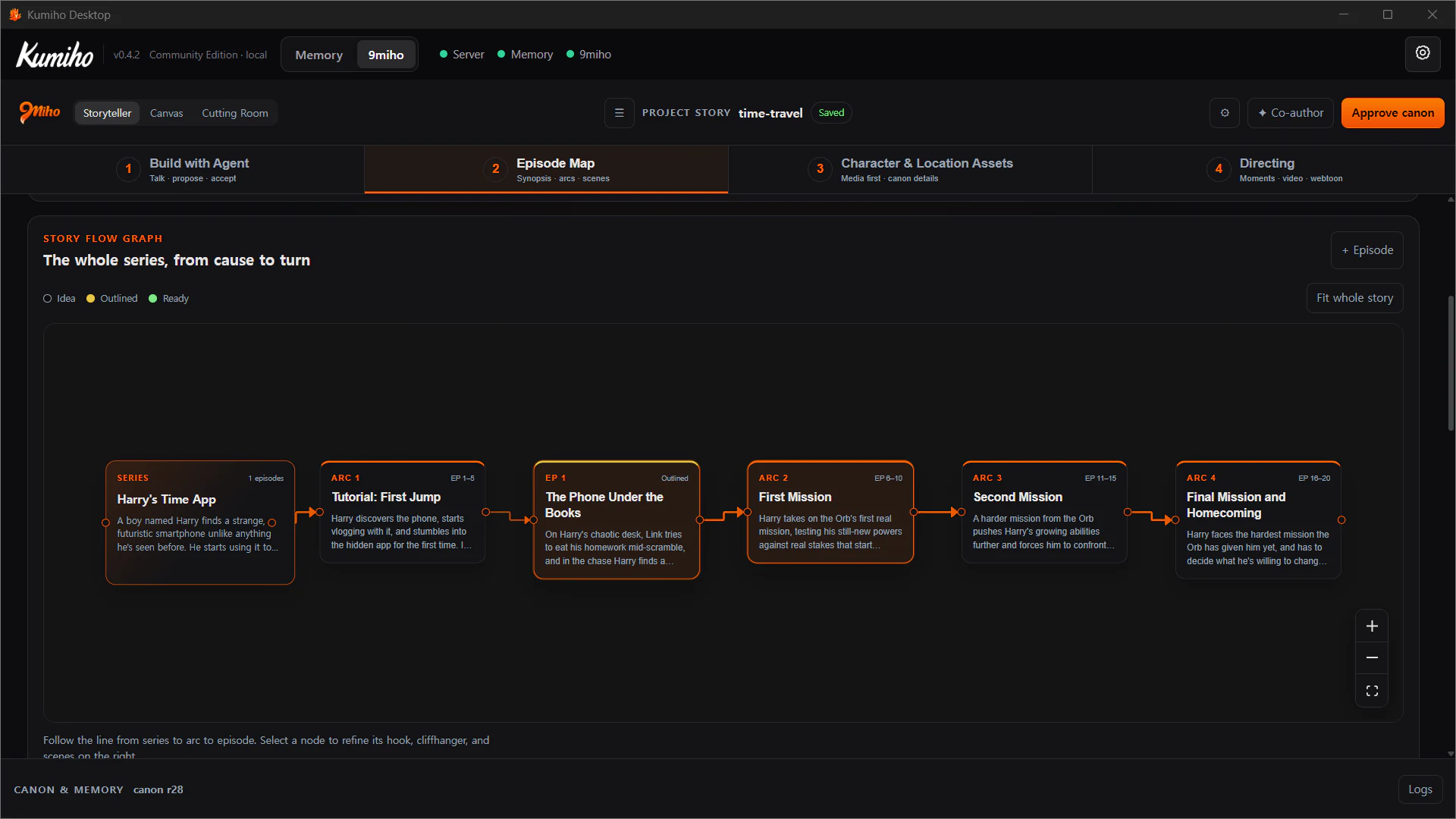
The Episode Map provides two purpose-built read-only graphs:
- Story Flow Graph presents Series, Arc, and Episode cards in causal reading order.
- Episode Cast Network shows only the characters and effective relationships relevant to the selected episode.
Select an Arc or Episode to inspect and edit its design, then move toward scene expansion or production. Status labels such as Idea, Outlined, and Ready make incompleteness visible rather than treating every generated outline as finished.
Although these views use graph rendering technology, they are not Canvas execution graphs. Story cards cannot be wired, dragged into a new truth, or connected to mutate Canon.
Agent proposals are structured operations
The Canon agent does not return prose that Storyteller blindly saves. It returns one proposal envelope containing typed operations, such as:
- add or update a character, location, prop, or relationship;
- update story premise, synopsis, format, or scope;
- add or revise an Arc or Episode;
- replace an Episode’s proposed Moment sequence;
- update one stable Moment without changing its neighbors.
The preview shows what will change. Accept applies it to the Draft, Edit lets the creator correct it first, and Reject records the decision without mutating the story.
Older destructive proposals may become stale when the Draft has moved on. Storyteller refuses unsafe rebases rather than pretending that every old suggestion can still apply cleanly.
Canon approval and versioning
Approval is a distinct operation after Draft editing. The exact submitted aggregate becomes a pinned Canon Revision and is projected into versioned story records.
Stable entities keep stable identity while their Revisions change. A Moment improved by an Assistant Director remains the same logical Moment Item; it gains another Revision. Episode membership and Moment content are versioned independently, so editing one Moment does not manufacture a false change to the entire membership list.
Production outputs link to the exact Canon and structural Revisions they used. If current Canon later changes, older media remains available but can be marked stale.
Temporal story truth
Storyteller is designed to prevent later knowledge from leaking backward into an earlier episode.
- Character state snapshots record the effective episode and source Moment.
- Relationship facts can have validity windows.
- Episode-local facts take priority over future series-summary information.
- Adjacent Moment state is checked so a character does not reset emotionally or physically without a cause.
The current UI does not claim a complete branching, merge, flashback, or bitemporal authoring system. It does preserve enough effective-time evidence to warn about future knowledge, ended relationships, and discontinuous state.
Planning a timed Moment sequence
For the focused short-episode path, Draft with Agent proposes a complete ordered sequence with count, duration, cast, location, WHAT/WHY, state deltas, and HOW. The proposal must use integer Moment durations and match the episode target before it can be accepted.
Review the complete sequence in Episode Flow, then choose Use this sequence, Regenerate, or Add manually. Accepting a sequence establishes story structure; it does not launch generation jobs or spend credits.
This boundary is deliberate: planning can be reviewed as one causal whole before any individual Moment becomes a paid media task.