Direction and model Dialects
Author one corpus-grounded, provider-neutral Direction, then let the consuming capability render it into the exact language and reference policy required by the selected model.
Direction separates the shot from the model
A normal prompt already speaks in somebody’s language. A Direction is the opposite: a validated, provider-neutral creative document that states what the media must be before the final consuming model is known.
It can describe:
- cast and exact reference bindings;
- staging, blocking, performer objectives, beats, and visible change;
- camera design and ordered shots;
- light, colour intent, production design, and continuity;
- dialogue, heard voice, ambience, effects, and music policy;
- constraints, locks, and what must not change.
The consuming capability chooses a Dialect at execution time. That keeps one creative decision inspectable while allowing different models to receive different structures, vocabulary, reference addressing, timing, and sound instructions.
Write a direction with an Assistant node
Choose Assistant → Write a direction. This is an executable graph task, not the Flow-editing Agent panel.
The node exposes controls including:
- Medium the direction is written for;
- creator instruction and up to eight wired reference images;
- Write a sequence;
- Shots in the sequence when sequence mode is enabled;
- validated Direction output and Director’s notes.
The selected agent turn receives the Direction JSON Schema and the relevant craft corpus. A video Direction corpus is intentionally substantial—roughly 50k characters in the current contract, with a smaller still corpus—because it carries real directing disciplines rather than a short style suffix.
Small-context agent models can truncate that evidence and return a thin Direction. Choose an agent model with enough context for the selected medium when the full directing contract matters.
Corpus-grounded directing, not a generic skill call
The Assistant does not rely only on a generic “write a cinematic prompt” skill. The craft corpus supplies shared contracts for continuity, reference ownership, cinematography, performance, timing, sound, and medium-specific production language.
The shared Acting Craft interface includes the FACS-informed observation and planning seam used by Storyteller. It organizes baseline, trigger, appraisal leak, control/action, and landing, then requires observable face, gaze, breath, hands, posture, and timing.
Raw Action Unit notation remains internal evidence. The compiled creative copy describes natural visible action; raw AU codes are not sent through a provider Dialect.
This is why a Direction can be more reliable than attaching a few agent instructions to an arbitrary prompt: the output must satisfy one typed document contract, with the same creative fields available for validation and later inspection.
What the consuming manifest declares
A compatible image or video Variant declares a prompt_profile rather than asking Canvas to branch on provider names. The profile identifies:
- which closed-set Dialect renderer to use;
- the Direction source port;
- the provider prompt target;
- how pinned references are addressed and ordered;
- where duration or other execution facts come from;
- any sound or capability-specific policy.
Two Variants can use the same Dialect but different reference contracts. Two models from one provider can use different Dialects. The seam follows capability truth, not brand assumptions.
Immediately before provider preflight, the runner validates the Direction, renders it with the selected profile, and records the exact prompt actually sent. The original Direction, rendered prompt, selected Variant, and resulting Take remain distinguishable in lineage.
One Direction, one consuming generation
One Direction normally feeds one consuming image or video generation.
shots[] inside the document are camera positions or cuts inside that one clip. They do not mean “launch one paid job per Shot.” If you need several later clips, enable Write a sequence to create 2–8 separate Directions. Every member is validated before publication and retains its own pinned reference inventory.
That sequence represents 2–8 separate downstream calls and cost boundaries. It is explicit rather than a hidden batch interpretation.
Prompt and Direction do not silently merge
A consuming node may support a normal prompt path or a Direction path. Supplying both where no merge contract exists is an error. The runner refuses the ambiguity instead of deciding which sentence wins.
Likewise, if the chosen model is unavailable, 9Miho does not silently substitute a different model and recompile the work. Availability depends on the exact Variant and configured execution profile.
Inspect the result
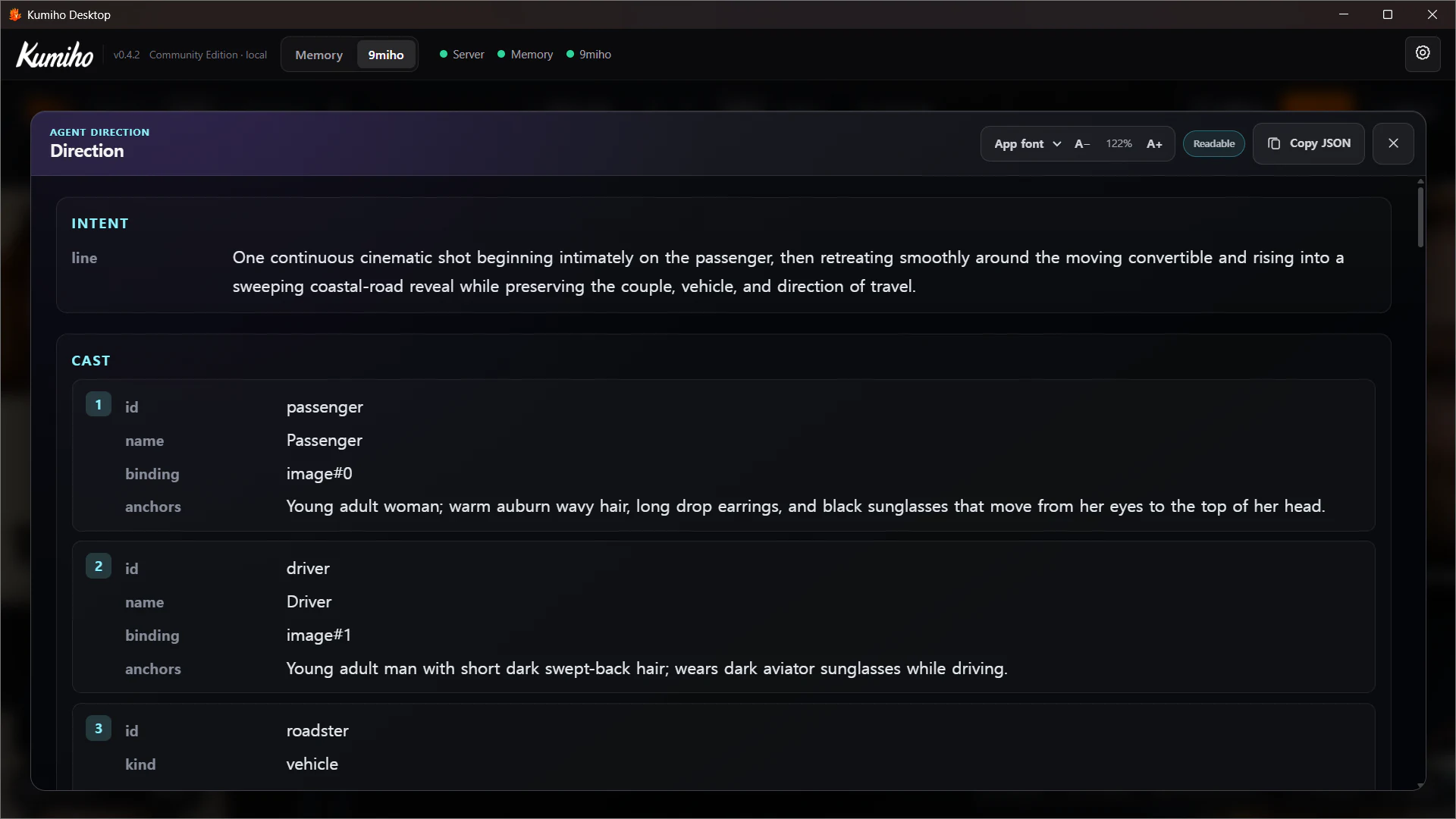
Open an Agent Direction output to inspect it in two forms:
- Readable — structured sections and cards for cast, performance, camera, audio, continuity, and constraints;
- Raw — the exact validated document for technical inspection and copying.
Text-size and typeface controls make long Direction documents practical to review. Readable mode is a presentation of the same underlying artifact, not a rewritten summary.
Direction is reusable evidence
Because Direction is stored as an artifact, it can be pinned, compared, wired to another compatible Variant, inspected beside the rendered prompt, and connected to the Take it produced.
That separation makes multi-model work possible without flattening all providers into one lowest-common-denominator prompt. The creative contract stays stable; only the execution language changes.