Storyteller overview
Develop Living Canon through conversation, map causal story structure, prepare approved visual identity, and direct one Moment into media without operating a generic node graph.
What Storyteller is
Storyteller is 9Miho’s guided, narrative-first production room. It turns an idea discovered through conversation into approved Canon, then carries that same truth through characters, locations, episodes, Moments, directing, and generated media.
It is designed for creators who need a story system rather than a blank graph. Storyteller presents story-specific forms and read-only workflow maps, while the shared Canvas execution system still handles real capability selection, validation, spend confirmation, generation, output registration, and lineage.
Storyteller removes the need to operate the generic node interface for this workflow. It does not replace Canvas, and Canvas remains directly available for graph authoring, automation, variations, and repeatable tasks.
The four-stage room
The top-level Storyteller workflow stays intentionally small:
- Build with Agent — discover the premise, scope, characters, relationships, places, and story questions through focused conversation.
- Episode Map — turn approved material into Story Promise, arcs, episodes, scenes, and ordered Moments.
- Character & Location Assets — create or link the pinned visual references that define recurring identities, places, and props.
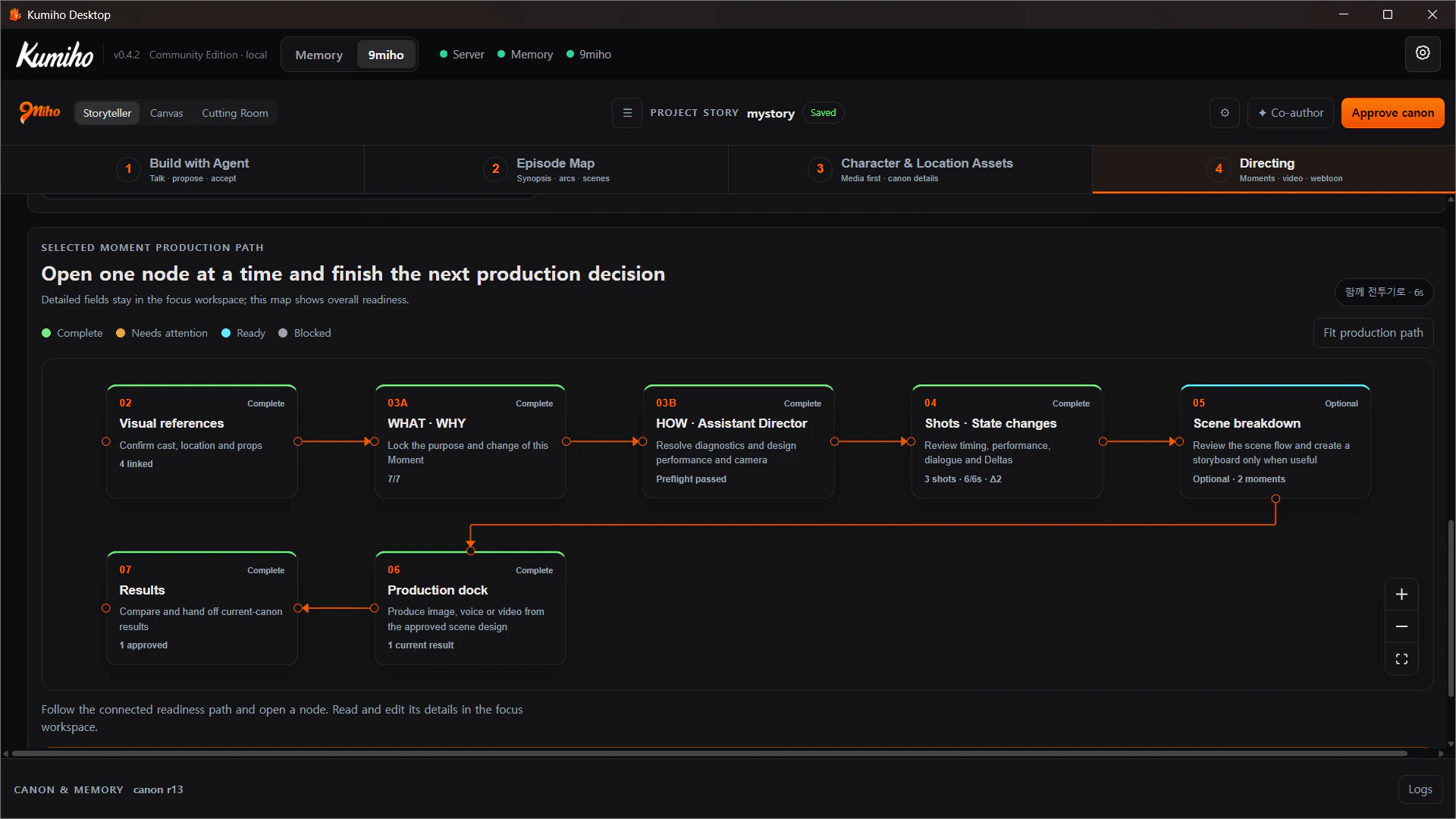
- Directing — protect the Moment’s WHAT and WHY while designing the performance, shots, camera, dialogue, sound, state changes, and production outputs that express its HOW.
Persistent links to Canvas, Cutting Room, Settings, and Logs make Storyteller one room in the production application, not a disconnected writing tool.
Conversation produces proposals, not silent edits
The Canon Builder lets you begin with fragments rather than filling in a long form. The agent asks at most one focused question, then returns a structured proposal that can be inspected before it affects the Draft.
Exact actions include Accept, Edit, and Reject. Proposal families can add or update story facts, characters, locations, props, relationships, arcs, episodes, Moment sequences, or a selected Moment. The conversation and the proposal envelope are separate: natural-language confidence does not bypass the review boundary.
Accepted and rejected decisions are retained in Canon decision history. A previous decision can be selected for revision without pretending the earlier choice never happened.
Draft and Canon are different states
Storyteller protects ordinary work from accidental approval:
- Text edits are automatically kept in a local Draft journal.
- Moving between characters, episodes, or Moments changes selection state, not Canon content.
- Accepting a proposal changes the Draft; it still does not publish Canon.
- Approve Canon pins the exact submitted document to a Canon Revision used by production.
- If the approved Canon changes elsewhere, Storyteller can protect the local Draft and offer an explicit restore/rebase path.
The built-in Storyteller agent returns reviewable proposals and cannot invoke Canon approval from that surface. External MCP is broader: it exposes approve_story_canon as a separate mutation whose tool contract requires direct user instruction, although the current server does not add a second human-confirmation gate. Paid Runs stop at their own itemized confirmation. Production always resolves from an explicit pinned Canon Revision.
What Storyteller owns
Storyteller owns the story contract:
- WHAT happened in this Moment;
- WHY the event, choice, or discovery matters;
- who is present and what they know at this point in time;
- the character state before and after the event;
- which references and outputs are approved for this story context.
Direction owns the filmable expression of that contract: performer objectives and actions, blocking, gaze, breath, camera, shots, light, dialogue, ambience, effects, and continuity. A directing proposal may improve HOW, but it must not invent a new event, relationship, or piece of Canon to make the shot easier.
A guided view over the shared graph system
For catalog-backed character images, storyboards, dialogue voice, Moment images, video, and Webtoon panels, Storyteller compiles a minimal hidden Canvas document from the approved production choices.
That document pins the required Canon, Direction, and reference Revisions; materializes the selected catalog Variant; validates its real ports and constraints; passes through the normal spend boundary; runs; and registers the resulting Take. Storyteller then records the approved output with its purpose and freshness.
Camera previz follows a different boundary. The browser authors and exports the Camera Plan and MP4 directly from pinned story inputs. The approved pair still participates in revision, approval, and lineage records, and a compatible video generation can later consume the MP4 as a pinned reference.
You do not wire these internal execution nodes from Storyteller. If you need to design a different graph, reuse outputs in a custom pipeline, or automate a repeatable task, open Canvas and work with the graph directly.
What Storyteller does not claim
- It does not turn an entire feature film into production-ready Moments with one click.
- Its most polished automatic timed-sequence planner is currently the focused short-episode path; broader long-form breakdown remains a creator-led process.
- It does not batch-render every Moment or automatically assemble a finished episode in Cutting Room.
- Stale outputs are not regenerated automatically.
- A storyboard is optional, not a mandatory gate for every production.
These boundaries keep the workflow useful without hiding paid jobs, overwriting story truth, or presenting speculative automation as completed production.